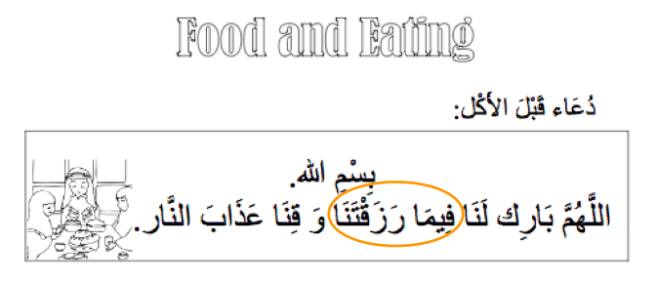
Word by word translation: فِيمَا رَزَقْتَنَا


Yesterday, we went through the word-by-word translation of اللَّهُمَّ بَارِكْ لَنَا.

(in case you’re joining us just now and want to know what we’re trying to do here and why, you can start with what my first trip to India taught me about learning languages — or start with our very first word-by-word translation lesson here.)

Today, we’ll be going through the part of the prayer that says فِيمَا رَزَقْتَنَا.
feemaa-razaqtanaa

فِيمَا

fee maa – in what

فِيمَا (feemaa) is actually two words joined together.

The first word is فِي (fee), which means “in”.  As with any preposition, you can imagine this is a very common word.  If you want to say “in the mosque”, you would say فِي الْمَسْجِدِ.  “In the house” is فِي الْبَيْتِ. “In the month of Ramadan” is فِي شهْرِ رَمَضَان.

The second word is مَا (maa), which means “what”.  It’s also a very common word.  When we say مَا شَاءَ الله (maa shaa Allah), that means “what God wants”.

رَزَقْتَنَا

razaqtanaa – you provided us

رَزَقْتَنَا (razaqtanaa) is two words put together (or three — if you consider the pronoun “you” to be a separate word):

رَزَقْتَ (razaqta) means “you provided”.

The root letters ر (raa) – ز (zaa) – ق (qaaf) give the meaning of provision or sustenance.  For example رِزْق (rizq) means “provision” or “sustenance”.

The suffix تَ means that “you (masculine singular)” are doing the verb.  If we change it from رَزَقْتَ (razaqta) to رَزَقْنَا (razaqnaa), you change the meaning from “you provided” to “we provided”.

The final suffix, نَا (naa) means “us”.  We saw this at the end of اللَّهُمَّ بَارِكْ لَنَا.  The نَا (naa) there in لَنَا (lanaa) means “for us”.  Here we see the same نَا (naa) in رَزَقْتَنَا (razaqtanaa), which means “you provided us”.  So again, نَا (naa) means “us”.

Next, we’ll be going through the final part of this du’a: وَ قِنَا عَذَابَ النَْار.

Word by word translation: اللَّهُمَّ بَارِكْ لَنَا

Moving forward with the translation of the prayer before eating from our Daily Athkaar series, we’ll now go through the meaning of اللَّهُمَّ بَارِكْ لَنَا.

allahumma baarik lanaa

اللَّهُمَّ

Allahumma – Oh God

This is often how we begin supplications / prayers / du’as.  It’s a way of directing your speech to God.

Another way that we start our du’as is by saying رَبَْنَا (rabbanaa), which means “Our Lord”.

بَارِكْ

baarik – bless

This is a command verb, which means it’s something that you’re directly asking the person you’re speaking to to do.  In this case, you’re asking God to bless something.

The root letters in this word are ب (baa), ر (raa) and ك (kaaf).  Other words that have those root letters will also have the meaning of blessing in them.  For example, بَرَكَة (barakah) means “blessing” and مُبَارَك (mubaarak) means “blessed”.

لَنَا

lanaa – for us

This is another case of two words which look like one. لَ (la) means “for” and نَا (naa) means “us”

In other places you might also see:

لَهُمْ (lahum) “for them”

لَكُمْ (lakum) “for you (plural)”

لَكَ (laka) “for you (singular masculine)”

So here it is in summary:

oh-god-bless-for-us

اللَّهُمَّ بَارِكْ لَنَا means “Oh God, bless for us”.

Next, we’ll translate فَيمَا رَزَقْتَنَا.


This post is part of a word-by-word translation series, which starts here.  This series was inspired by language learning lessons which I picked up during my trip to India.


Word by word translation: دُعَاء قَبْلَ الْأَكْل

Last week, I shared my experience of learning a new language from scratch from my time in India.

The main take-away was that it’s best to learn just a few words at a time but on a very consistent basis (we’re still working on the consistency bit here on our end, but we can at least start the few-words-at-a-time part right now 🙂 ).

We’re going to start learning the meanings of the words in the prayer that you read before eating, which was introduced a couple of weeks ago.

Right now, we’re going to go over the first three words that you see on the page here: Continue reading

Daily Athkaar for Muslim Kids – Part 1: Food and Eating (Continued)

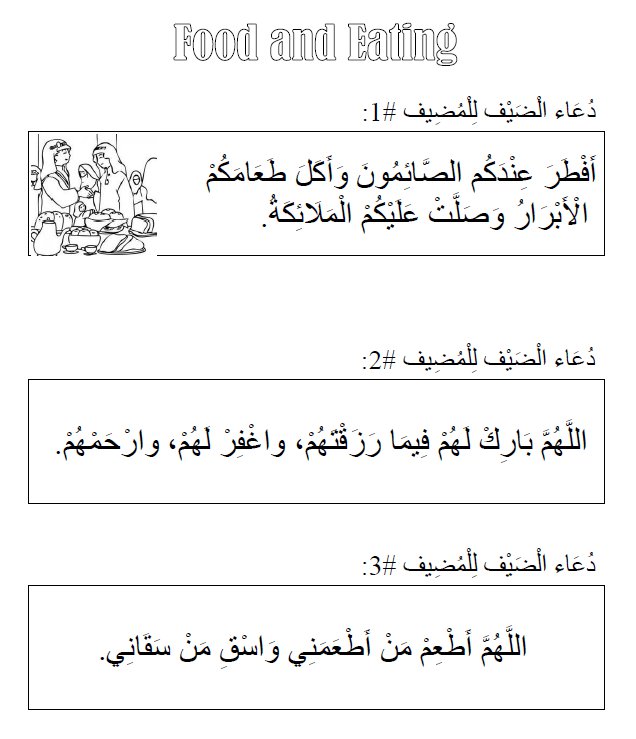
We recently started our series of Daily Athkaar for Muslim Kids encouraging our kids – and ourselves too- to remember Allah (God) in every aspect of their daily life. We started off with the “Food and Eating Athkaar” and we mentioned that one of the sunnah etiquettes of eating, is to remember the person who provided the food for us. This includes the hosts, the one who cooked the food and the one who paid for it.

We can remember the host with any du‘aa and kind words, but according to our references, there are three famous du‘aa that were reported in the sunnah. You can download the PDF file of the du‘aa for the host here, you will find the Arabic du‘aa, translation and transliteration as we mentioned in our previous Athkaar post. You can learn and teach your kids any of them according to their age and level of understanding of the Arabic language. I would suggest the du‘aa #3 for beginners.

Athkaar_1_cont

To receive the rest of the Athkaar series, and get a free pack of printable Arabic flashcards, do not forget to subscribe to our mailing list by clicking here.

We would love to hear from you so please feel free to add a comment, or send us an email LearningArabee@gmail.com or send us a message on our FaceBook page: https://www.facebook.com/LearningArabee/


Eid Greetings in Arabic

I love Eid.  I especially love greeting everyone after Eid prayers and hugging and giving air kisses.

I do, however, have very clear memories of going around after Eid and my Arab friends would say this thing “kul…something something…bi khayr” and I had no idea what they were saying, what it meant or how I was supposed to respond.  So I would smile awkwardly and nod.

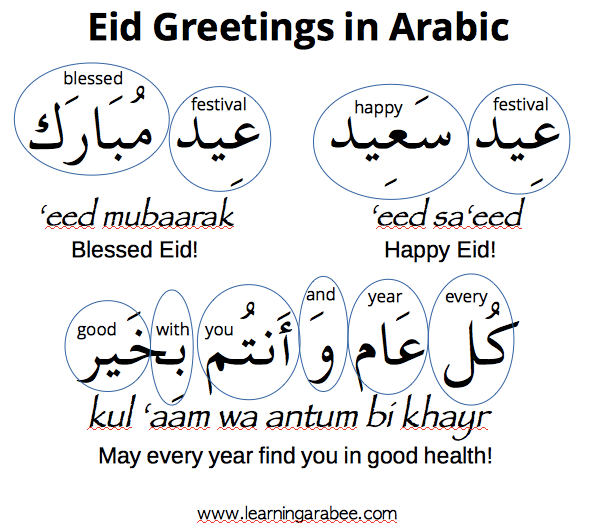
To help you avoid such awkwardness, here’s quick summary of some common Arabic Eid greetings, their transliteration, what they mean and a word-by-word breakdown of the meaning.

Eid Mubarak!

Eid Greetings in Arabic

p.s. if you want to make some Eid cards with the kids or practice writing some of these greetings, check out the instructions for the Pop Up Eid card, which includes the downloadable Eid greeting writing guide.


To get these posts delivered straight to your inbox, subscribe to our mailing list here.

Translation of the Arabic Alphabet Song

To help you sing along and pick up vocabulary, we’ve just updated the alphabet song with both English and Arabic subtitles 🙂

Here are the lyrics to the song in Arabic plus the transliteration and English translation:

أَلِفٌ أَرْنَب، يَجْرِي يَلْعَب

Alifun arnab, yajree yal‘ab

Alif is for rabbit, who runs and plays

يَأْكُلُ جَزَرَاً كَي لَا يَتْعَب

ya’kulu jazaran kay la yat‘ab

he eats carrots so he does not get tired

Continue reading

Arabic Alphabet Song

Watch this super cute and catchy Arabic Alphabet song!

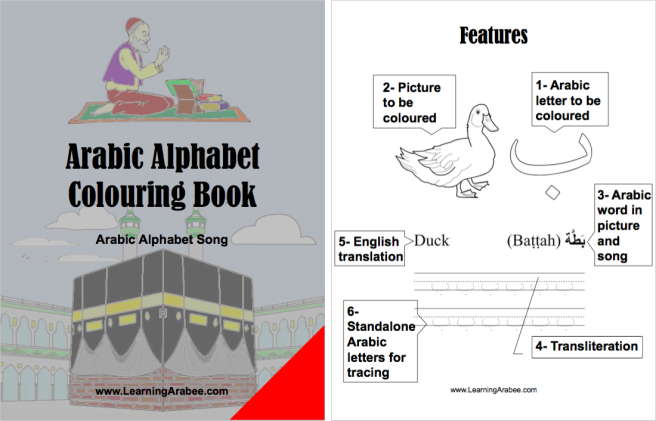
This song has some pretty sophisticated vocabulary, making it a great learning tool for a wide range of skill levels. Little ones will be mesmerized by the tune and pictures as they learn their alphabet, while older ones and adults can pick up lots of new words and a variety of grammatical structures from the verses.

Continue reading