Word by word translation: وَ قِنَا عَذَابَ النَّار

In our last instalment of this word-by-word translation series, we went through the translation of فِيمَا رَزَقْتَنَا.  Now, we’re going to finish translating the last few words of the du’a.

wa-qinaa-athaab-an-naar

وَ

wa – and

وَ (wa) means “and”.  It’s a very common word.  Sometimes, depending on the context, وَ can be translated as “though” or “while” or “when”, but most commonly, it means “and”.

For example, when someone greets you with السَّلامُ عَلَيكُمْ (assalaamu ‘alaykum) “peace be upon you”, you respond with وَ عَلَيْكُمْ السَّلَام (wa ‘alaykum assalaam) “and upon you be peace”.  That وَ (wa) at the beginning means “and”.

You’ll also hear وَ when we want to connect or list things together, like:

اَنَا وَ اُخْتِي (anaa wa ukhtee) “I and my sister”

السَّماوَاتِ وَ الْاَرْض (assamaawaati wal ard) “the heavens and the earth”

or الشَّمْس وَ الْقَمَر (ashams wal qamar) “the sun and the moon”.

قِنَا

qinaa – protect us

The first word, قِ (qi) is a command verb asking someone to “protect”.

The second word, نَا (naa), is one we’ve seen twice already in this du’a and it means “us”.

عَذَابَ

‘athaab – punishment

You’ll often see the word عذَاب in a phrase like ِعذَاب النَّار (‘athaab annaar) “punishment of the fire” or ِعَذَاب الْقَبْر (‘athaab alqabr) “punishment of the grave”.

You’ll notice that both phrases include the word “of” in the English translation even though there’s no apparent corresponding word in Arabic.  That meaning comes from the مُضَاف (muḍaaf) –  مُضَاف اٍلَيْه (muḍaaf ilayh) structure, which we learned about earlier, when translating بِسْمِ الله

النَّار

naar – the fire

ال (al) means “the” and نَار (naar) means “fire”.  Interestingly, the Arabic word for fire is similar to the word for light, which is نُور (noor).

That’s it 🙂  We’ve finished the word-by-word translation of this first du’a.  Here’s a link to all the previous posts:

Word by word translation: دُعَاء قَبْلَ الْأَكْل

Word by word translation: بِسْمِ الله

Word by word translation: اللَّهُمَّ بَارِكْ لَنَا

Word by word translation: فِيمَا رَزَقْتَنَا

“The Curse of Knowledge” and Lessons on Learning From My Trip to India

There’s something called “The Curse of Knowledge”.

einsteincurse.png

It’s the fact that once you know something, it’s hard to remember what it was like when you didn’t know it.

For example, once you learn a language, you tend to forget the things about that language that used to be challenging or difficult for you.  You forget all the details and concepts you struggled with and what you didn’t understand.

“The Curse of Knowledge” makes it difficult to be a good teacher because you can’t relate to the student 100%.  You’re standing in very different places with very different views.

I was reminded of this recently when I went to India for the first time. Continue reading

Daily Athkaar Series for Muslim Kids

We are pleased to present this informative series of daily athkaar for Muslim kids in order to help memorizing them, or remembering them during the kids daily routine. Our reference is “Alwaabil aṣṣayyib min alkalim aṭṭayyib” (Arabic: الوابل الصيب من الكلم الطيب ), which is a book by the Islamic scholar Ibn Alqayyim Aljawziyyah.

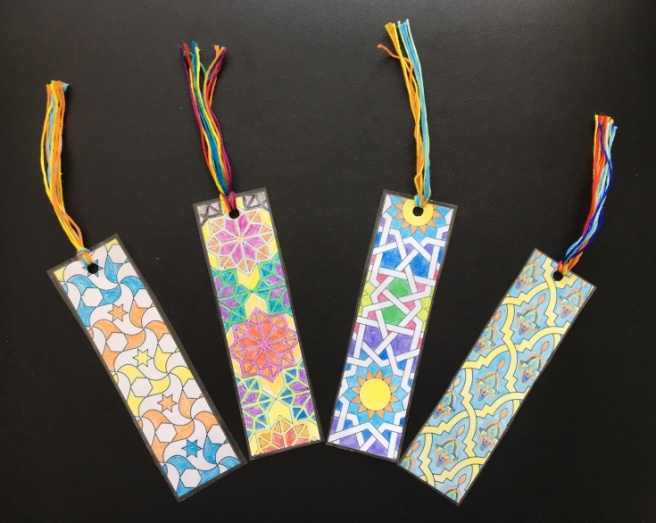
You can print single sided pages and compile them in a folder, or cut and stick them on the wall for reminding the children to say their athkaar. You can also print a double sided page and cut the athkaar boxes, laminate them and use them as flash cards and/or bookmarks.

Part 1: Food and Eating

Our first set of athkaar, is related to food and eating. We started with the etiquette from the sunnah in the first page. We have included the original Arabic script on one page, and on the following page we have included the transliteration in black and the translation in red. You can download your FREE pdf file by pressing this link.

You can find the pronunciation table that we are using in all transliteration here: https://learningarabee.com/pronunciation/. If you have any comments or suggestions, please feel free to email us at LearningArabee@gmail.com or send us a message on FaceBook: https://www.facebook.com/LearningArabee/

And do not forget, if you want to keep updated with all our posts, subscribe to our mailing list by pressing here.

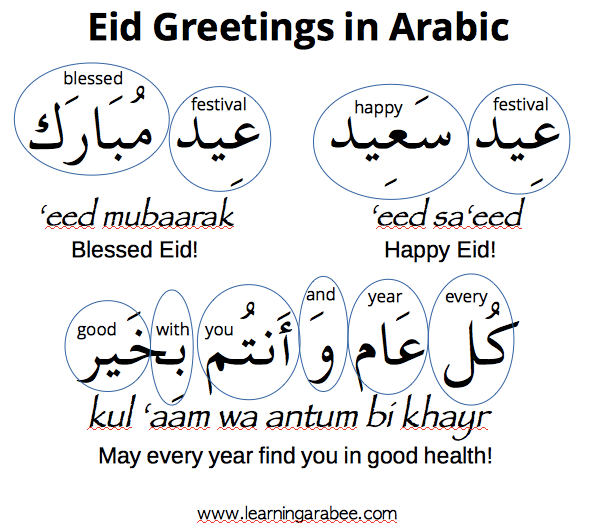
Eid Greetings in Arabic

I love Eid.  I especially love greeting everyone after Eid prayers and hugging and giving air kisses.

I do, however, have very clear memories of going around after Eid and my Arab friends would say this thing “kul…something something…bi khayr” and I had no idea what they were saying, what it meant or how I was supposed to respond.  So I would smile awkwardly and nod.

To help you avoid such awkwardness, here’s quick summary of some common Arabic Eid greetings, their transliteration, what they mean and a word-by-word breakdown of the meaning.

Eid Mubarak!

Eid Greetings in Arabic

p.s. if you want to make some Eid cards with the kids or practice writing some of these greetings, check out the instructions for the Pop Up Eid card, which includes the downloadable Eid greeting writing guide.


To get these posts delivered straight to your inbox, subscribe to our mailing list here.

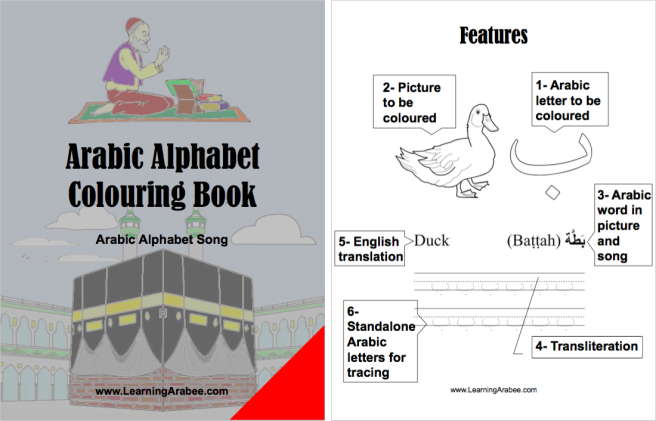
Translation of the Arabic Alphabet Song

To help you sing along and pick up vocabulary, we’ve just updated the alphabet song with both English and Arabic subtitles 🙂

Here are the lyrics to the song in Arabic plus the transliteration and English translation:

أَلِفٌ أَرْنَب، يَجْرِي يَلْعَب

Alifun arnab, yajree yal‘ab

Alif is for rabbit, who runs and plays

يَأْكُلُ جَزَرَاً كَي لَا يَتْعَب

ya’kulu jazaran kay la yat‘ab

he eats carrots so he does not get tired

Continue reading

Arabic Alphabet Song

Watch this super cute and catchy Arabic Alphabet song!

This song has some pretty sophisticated vocabulary, making it a great learning tool for a wide range of skill levels. Little ones will be mesmerized by the tune and pictures as they learn their alphabet, while older ones and adults can pick up lots of new words and a variety of grammatical structures from the verses.

Continue reading